


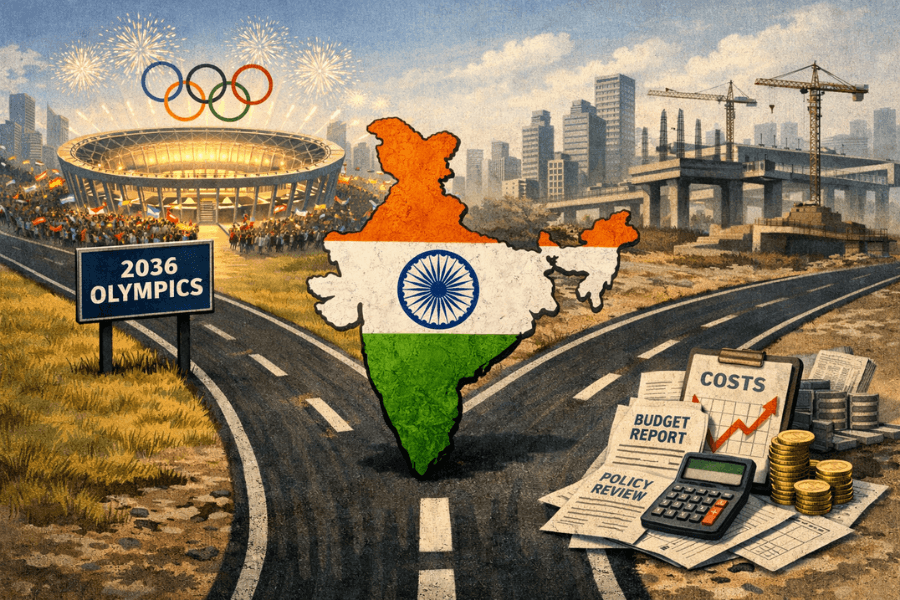
Mega sporting events have long carried a special allure. Beyond athletic excellence and global spectacle, they are seen as markers of national confidence – signals that a country is ready to host the world, both literally and symbolically. India’s interest in hosting the 2036 Olympics reflects this aspiration. It aligns with a broader vision of global engagement, urban transformation, and soft power. Yet as more countries reassess their own experiences, a critical question has come to the fore: under what conditions does hosting such events genuinely serve long-term national interest?
Global Learning: From Optimism to Economic Realism
Over the past two decades, global evidence has increasingly challenged the assumption that mega sporting events reliably deliver lasting economic gains. While projections often highlight tourism surges, infrastructure creation, and employment generation, ex post analyses tell a more sobering story. Studies examining past Olympics – from Rio and Tokyo to Sochi – suggest that initial economic benefits are often overestimated, costs routinely overshoot projections, and long-term impacts on growth, trade, or employment fall short of expectations.


There are notable exceptions that underscore the role of institutional design. The Los Angeles 1984 Olympics illustrates how outcomes can differ when hosting is anchored in disciplined cost control, robust private participation, and firm revenue negotiations, aligning organiser incentives with fiscal outcomes. The Games generated an operating surplus and are often cited as a case where hosting aligned economic incentives with execution capacity.
This growing realism has reshaped public and policy attitudes worldwide. Several cities and countries – Hamburg, Boston, Budapest, and Rome – have withdrawn from bidding altogether, citing the high upfront costs of hosting and the uncertain returns.
A similar pattern has emerged in the Commonwealth Games, reinforcing that governance and cost pressures are not confined to the largest global events. Recent withdrawals by confirmed or prospective hosts – including Victoria, Malaysia, and Durban – citing escalating costs and fiscal constraints, have forced the Games to be scaled down or reassigned. The experience underscores that even comparatively smaller multi-sport events can strain public finances when institutional capacity and cost discipline are weak.


These developments point to a broader global lesson – not that mega sporting events are inherently undesirable, but that their success depends heavily on institutional design, cost discipline, and governance capacity.
India’s Stakes: Higher Opportunity, Higher Risk
For India, this lesson carries special significance. As a developing economy with substantial infrastructure needs, limited fiscal space, and ambitious social priorities, the opportunity cost of large public expenditures is high.
India also stands to gain more than many countries if such events are executed well. Investments in transport, housing, urban services, and sporting infrastructure can yield durable dividends – provided they are embedded within broader development strategies rather than treated as standalone prestige projects.


India’s challenge, therefore, is not about ambition, but about alignment: aligning aspiration with economic realism.
The Conditional Core: When Hosting Works
Experience suggests that hosting mega sporting events tends to deliver positive outcomes only when certain conditions are firmly in place.
The first is rigorous cost discipline rooted in institutional design rather than intent alone. For India, transparency around budgeting, procurement, and execution is not merely a governance ideal but a confidence-building necessity. A professionally managed special purpose vehicle, operating under strict public audit norms, can help ensure that financial discipline is structural rather than discretionary.
The second condition concerns revenue sharing and financial returns. The second condition concerns revenue sharing and financial returns. For India, the core issue is how risk and return are allocated. Revenue models must be negotiated as strategic economic arrangements rather than ceremonial partnerships, with clear limits on public exposure and realistic expectations of spillovers – given the asymmetry in bargaining power between host governments and sporting federations.
The third condition is innovation in financing. Greater reliance on private capital, sponsorships, and commercial partnerships can reduce fiscal exposure and distribute risk more evenly. Recent experiments with naming rights and corporate partnerships demonstrate how private participation can supplement public investment. However, such models must be carefully designed to preserve public trust, avoid perceptions of favouritism, and ensure that public assets continue to serve public purposes.
Transparent processes, credible financial planning, and clear accountability mechanisms are consequential: failures in oversight can rapidly erode public trust, constrain future policy space, and weaken the legitimacy of large public investments.
Ambition Needs Architecture
Mega sporting events continue to shape cultural experiences, inspire participation in sport, and create moments of shared global attention. For a country like India, they also offer an opportunity to demonstrate institutional maturity and project a distinctive development model. But that opportunity will be realised only if hosting is treated as a governance challenge rather than a symbolic milestone.
As India advances its long-term development vision, the real test will not be whether it can host the world, but whether it can do so on terms that are fiscally responsible, institutionally sound, and publicly credible. Ambition delivers its greatest returns when matched by architecture.

