

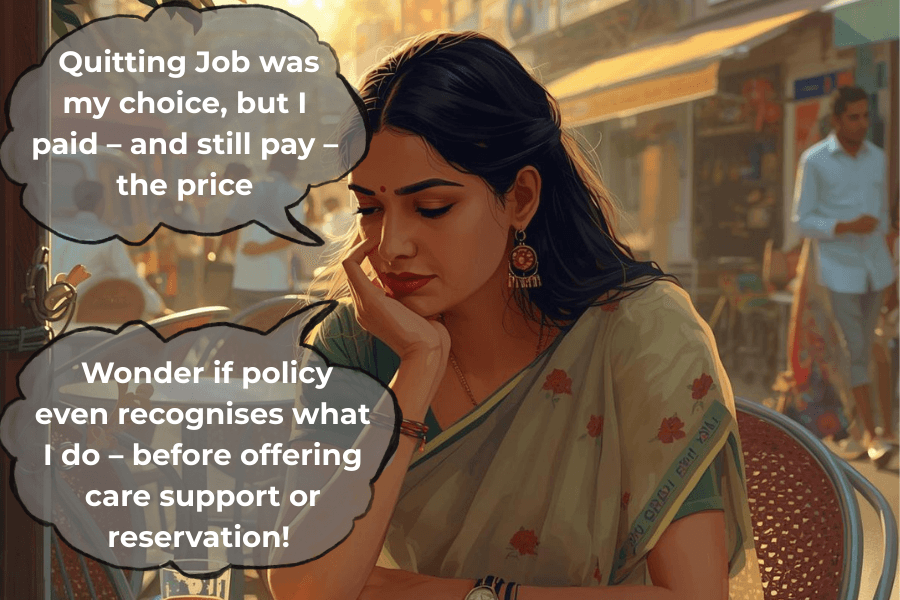
Eight months ago, Shraddha Srivastava resigned from her position as an assistant professor at a private university. She was an early-career faculty on a teaching and content development intensive contract, a setting where expectations of availability are informal but persistent, and where career progression depends as much on visibility as on output.
Her decision did not emerge from a single moment of crisis. It took shape over time, informed by questions of time, emotional bandwidth, professional expectation, and the everyday demands of caring for two young children. Shraddha describes the exit as neither impulsive nor externally imposed – yet not entirely free of constraint.


“I did not leave because I could not work,” Shraddha says, “but because continuing to work demanded a version of me that was no longer sustainable alongside caregiving.”
This distinction matters. Public and policy discussions often frame women’s exit from paid work as a breakdown triggered by the absence of childcare, workplace flexibility, or safety. Shraddha’s experience points to a more complex reality: exit as a deliberate decision made within constraints rather than simply because of them – a choice that feels voluntary, yet is shaped by what can be sustained over time.
The Policy Blind Spot: How Exit Decisions Are Actually Made
Shraddha reflects on how swift and predictable the responses to her decision were. Many assumed that leaving paid work must signal compulsion, irrationality, or a lack of foresight – an expectation that exit requires an external failure to justify it. Policy frameworks often mirror this assumption.


“People around me asked why I would leave a stable salary, as if the only explanation must be compulsion or foolishness,” Shraddha reflects.
Most policy approaches rest on a linear logic: women leave work because systems push them out; fix those systems and women will return. Infrastructure such as crèches, flexible hours, and parental leave is therefore treated as both diagnosis and remedy. While such measures are necessary, Shraddha’s experience suggests they are not always sufficient. When exit reflects a decision shaped by identity, values, and trade-offs – rather than a single binding constraint – policy tools risk reaching a point where further effort delivers diminishing returns.
The weeks before Shraddha’s resignation were marked not by certainty, but by continuous recalibration. Each accommodation she tried to make – adjusting schedules, stretching weekends, redistributing attention – delayed the decision without resolving it.


“There was no single breaking point,” Shraddha says. “It was a slow realisation that every adjustment was temporary, and that the strain was cumulative.”
Policy is often structured around clear thresholds shaping such decisions: childcare availability, flexible schedules, income cushions. Shraddha’s experience suggests instead that decision-making unfolds through accumulation – of mounting fatigue, overlapping roles, and cognitive overload–none of which registers cleanly in institutional metrics. Exit, in this sense, is not triggered; it is arrived at.
Flexibility as a Holding Pattern, Not a Resolution
Importantly, the presence of options did not automatically translate into relief. The ability to “manage somehow” often postponed exit rather than preventing it, as each accommodation bought time without easing the underlying strain.
“What looked like coping from the outside,” Shraddha says, “felt like erosion from within.”
Flexibility, in this sense, functioned less as a solution and more as a holding pattern.
This gap between institutional intent and lived experience helps explain why policy evaluations often overestimate impact. Interventions are typically assessed at the point of provision – whether flexibility exists – rather than at the point of decision, where the relevant question is whether such measures meaningfully change what feels manageable and sustainable in daily life.
The Hidden Costs of “Choice”: Identity, Status, and Loss
Shraddha is careful not to romanticise agency. While the decision to exit was deliberate, it was far from cost-free. Policy literature has long recognised visible costs such as forgone income, pension insecurity, and skill depreciation. Shraddha points to a different register of loss.
“What I lost was not only a salary, but a publicly recognised identity that had taken years to build,” she says.
Paid work, she emphasises, is not merely a source of income. It structures time, confers status, and offers external validation. Care work, while emotionally meaningful, lacks formal recognition, progression, and boundaries.
“What I gained was emotional stability. I was no longer constantly stretched,” Shraddha notes. “But what I relinquished was the daily affirmation that comes from being professionally visible.”
These losses – felt immediately as diminished visibility, experienced over time as narrowing options, and later as penalties when attempting to return – remain largely invisible in policy design. Shraddha’s experience suggests that choice does not eliminate cost; it merely shifts where that cost is borne.
This helps explain why policy responses that seek to compensate for exit through income replacement or symbolic recognition often fall short. They address economic loss but leave psychological trade-offs unresolved. Work operates not only as an economic activity, but as a psychological institution that shapes status, time, and self-worth.
Asymmetry and Irreversibility: Why Exit Decisions Persist
Even when caregiving brings fulfilment, the loss of professional status can feel disproportionately heavy. Anxiety about re-entry often outweighs the immediate benefits of family stability.
“Even when the decision felt right,” Shraddha recalls, “the anxiety about what I was giving up did not disappear.”
These asymmetries help explain why exits tend to persist even when external conditions improve. Skills decay, networks weaken, and employers discount career gaps. What begins as a temporary adjustment often hardens into long-term disadvantage.
“I realised that returning would not mean resuming from where I paused, but starting from a lower rung altogether,” Shraddha reflects.
Policy frequently assumes reversibility where none exists. Exit is treated as a pause rather than a permanent downgrading of professional standing, compounding inequality by penalising those whose exits were rational responses to life-stage pressures.
Care Is Not Fully Substitutable
Shraddha is sceptical of policy narratives that assume care responsibilities can be modularly replaced. Crèches and eldercare facilities can reduce burden, but they do not replicate emotional presence.
“My children do not need supervision alone,” Shraddha says. “They need presence.”
Care, she emphasises, is relational and continuous. Treating women as fully transferable labour overlooks aspects of caregiving that cannot be substituted by services or infrastructure. Policy can enable partial mobility, but it cannot assume smooth or costless movement from household to workplace.
What Policy Must Rethink About Women’s Work
Shraddha’s experience exposes the limits of treating labour-force participation as the primary indicator of women’s empowerment.
“The problem is not that women leave work,” Shraddha says, “but that systems are built as if staying continuously employed is the only legitimate path.”
Policy must therefore recognise hybrid, cyclical, and discontinuous work trajectories; decouple social protection from uninterrupted employment; and account for identity costs and behavioural asymmetries. Without this shift, even well-designed interventions will continue to disappoint.
From Empathy to Institutional Clarity
Respecting women’s choices is necessary, but insufficient.
“Identity cannot be reduced to income,” Shraddha reflects, “but neither can it survive without institutional support that signals value, security, respect, and recognition for work – even when unpaid.”
Until policy frameworks account for how identity, psychology, and asymmetry shape exit decisions, they will continue to mistake design limits for implementation failures – and deliberate exits for problems to be corrected.

