


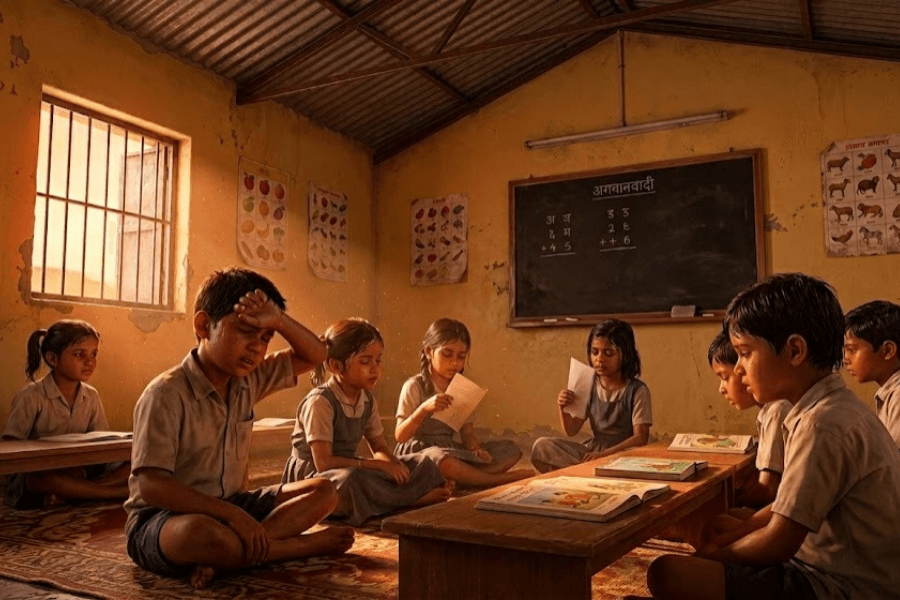
In April 2024, the Indian state of Kerala recorded 16 days above 40°C – an unprecedented spike for the state with the previous high being 8 days in 2016. Many other Indian states and cities experienced similar extremes. Yet for thousands of Anganwadis under the Integrated Child Development Services (ICDS), these temperatures did not trigger any formal protection or adjustment, leaving preschoolers to spend four to six hours a day inside single-room structures that trap heat – precisely when children are most cognitively vulnerable.
What stands out is not merely the severity of recent heat, but the absence of systematic protection for early childhood spaces. This institutional gap matters because early childhood is when cognitive and behavioural foundations are laid, and environmental stress at this stage can weaken the returns from later public investments in education.


Why Heat Damages Learning Before Schooling Begins
Heat affects the brain directly. Elevated ambient temperatures increase brain temperature, disrupt neural functioning, and reduce the ability to concentrate – even on simple tasks. Preschool-aged children are particularly vulnerable because their bodies regulate heat less efficiently than adults, and their tolerance thresholds are lower. What registers as discomfort for adults can translate into cognitive impairment for young children.
In Anganwadis, structural constraints magnify this vulnerability. Poor insulation, limited ventilation, and concrete or tin roofs allow solar heat to build up steadily through the day. These conditions disproportionately affect children from poorer households, Scheduled Caste and Scheduled Tribe communities, and girls, who rely most on public childcare and have fewer alternatives for cooling at home.


Heat exposure thus becomes a quiet but powerful channel through which early cognitive deficits reduce the productivity of later educational investments, and inequality in human capital formation is reinforced.
Thermal Stress Inside the Care Environment
Heat shapes not only children’s learning but also the care environment. Anganwadi workers operate under the same thermal conditions, and higher temperatures increase fatigue, discomfort, and stress. This matters because early learning at the preschool level depends heavily on sustained attention, emotional regulation, and responsive interaction from caregivers. Under heat stress, reduced patience, lower responsiveness, and diminished engagement can weaken classroom dynamics, amplifying behavioural strain among children rather than compensating for it.


What Passive Cooling Achieves
Against this backdrop, the effectiveness of a simple physical adaptation is striking. High-albedo white roof paint – commonly referred to as a “cool roof” – reflects a large share of incoming solar radiation, reducing heat absorption without electricity or mechanical cooling.
In a recent intervention, the Energy Management Centre (EMC) of the government of Kerala applied this paint in Anganwadis across 5 panchayats in Thiruvananthapuram district. An impact evaluation of the same making use of a randomized controlled trial design showed encouraging results. Roof surface temperatures were around 11°C lower than in untreated centres, and ceiling temperatures fell by about 5°C. These physical changes translated into an average reduction of roughly 1.3°C in daily maximum indoor temperatures – a difference that persisted through the peak heat months.
The human effects were equally important. Surveys conducted with Anganwadi staff showed significant reductions in perceived heat and thermal discomfort during late morning and early afternoon hours when classrooms are usually most stifling. For children, performance on a simple, age-appropriate puzzle task improved by about 6.4 percent relative to baseline. This gain emerged despite the task being deliberately kept easy – nearly 90 percent of children could complete it even before the intervention – suggesting that observed improvements may understate the benefits of cooling under more cognitively demanding learning conditions.
Attendance did not increase, largely because April and May already see seasonal declines due to school holidays, travel, and because the study period coincided with a week-long heatwave-related closure across Kerala. This distinction matters for policy design: cooling improves the quality of time spent in classrooms, not necessarily the number of days attended.
Cost, Scale, and Feasibility
The case for passive cooling strengthens when costs are considered. Applying reflective paint to an Anganwadi roof costs approximately ₹19,500, including materials and labour. Assuming a conservative lifespan of five years and annual maintenance of about ₹1,500 for periodic cleaning, the cost works out to roughly ₹1 per child per day in a typical centre with 15 children.
By comparison, cooling the same space with a 1.5-tonne air-conditioning unit would cost about ₹5 per child per day in electricity alone, assuming realistic load factors and prevailing tariffs. Air-conditioning also presumes reliable power supply and increases energy demand, making it poorly suited for large-scale deployment across India’s 1.4 million Anganwadis. Passive cooling via the use of reflective paint, unlike air-conditioning, is also not emission intensive .
These figures matter because they place thermal safety well within existing expenditure envelopes. ICDS already allocates ₹8 per child per day for supplementary nutrition at the central level, with state and local contributions in Kerala often raising this to ₹10–20. Relative to these recurring costs, passive cooling represents a marginal but potentially high-return investment.
Institutions and the Missing Standards Problem
The main barriers to scale are institutional rather than technical. Procurement systems must ensure paint quality and durability, particularly in monsoon-prone regions. More fundamentally, Anganwadis fall between policy silos: early childhood services are administered under social-sector frameworks, while climate adaptation financing sits elsewhere.
An additional gap lies in regulation. Neither ICDS guidelines nor education standards specify thermal comfort requirements for early learning spaces. As a result, heat exposure remains an unaddressed design feature rather than a recognised service-quality issue.
Integrating passive cooling norms into construction and renovation guidelines would address this omission without creating new delivery mechanisms.
Early Cognition as Adaptation
Climate adaptation in education need not be technologically complex or fiscally burdensome. Even modest improvements in early learning environments can have lasting consequences, because early cognitive gains enhance the productivity of later investments in schooling.
As temperatures rise, protecting early cognition becomes a core component of adaptation policy. Roofs may appear mundane, but when redesigned with climate in mind, they can quietly safeguard learning at the moment it matters most.

